
St. George Clerk Docket Requests
District Court files for St. George live with the Fifth District clerk. Send the full case number when you have it. Add the party name, case type, filing year, and the exact record you want. Audio requests need the hearing date and the time. Give your preferred format as well. Email stgcopies@utcourts.gov for copies and audio locally, and call the main court number for current instructions. The Washington County Justice Court keeps its own clerk and its own files. For a docket from that limited-jurisdiction court, the request changes a little. Give the citation number and the violation date. Say whether you want a calendar entry, docket history, a document, or a certified copy. The Washington County Clerk/Auditor serves as clerk for neither court.
St. George Xchange Docket Checks
Think through an Xchange query before you pay. Pick the known court first. Enter the complete case number next. A name alone works better with a filing year and case category attached, since a broad statewide name search can pull unrelated cases and still count as billable. Keep St. George District Court and Washington County Justice Court separate as location choices. The result grid shows county, court, case type, number, filing date, and party role. Check those fields before opening Case History/Documents. Expanded history can list charges, filings, and hearings. Plea, disposition, orders, due dates, accounting, and public documents appear there too. Match any Utah code against the official code list. For a material outcome, read the actual order rather than trusting the summary line. Guest terms set a one-time account cost, a per-search charge, and a separate document price. Free Xchange access exists at the Utah State Law Library, and some courthouses may offer public terminals; confirm hours and printing before you go. These routes find information without certifying it. Take the matched number to the right St. George clerk for certification, audio, or a restricted-record decision.
Searching the St. George Court Docket
Read the court line on your source document first. Felonies, class A misdemeanors, probate, domestic cases, and ordinary civil matters generally land in the St. George District Court. Traffic citations may belong to Washington County Justice Court instead. So may lower-level criminal charges, infractions, and ordinance cases. The official county location list shows no separate St. George Justice Court. A docket search aimed at an assumed city venue can miss the St. George court docket entirely. Utah Courts Xchange covers both courts. It carries public case information from District and Justice Courts alike. For a current hearing date, the public Utah calendar is the better tool. MyCase serves a different purpose. It lets a party manage that party's own case, not run a general public name search.
- Read the court and issuing agency on the notice or citation.
- Select St. George District Court or the named Justice Court in Xchange.
- Use the complete case number, or narrow a name with court, type, and year.
- Check the Utah calendar for the current hearing mode, room, and time.
- Ask the correct clerk to confirm a setting or supply a certified record.
St. George Docket Venue Clues
A city name alone tells you nothing about the record keeper. The District Court and the Fifth District Juvenile Court share the state complex at 206 West Tabernacle. The county Justice Court currently lists 197 East Tabernacle, though an older county location page still gives 111 East East Tabernacle...
| Clue | Likely docket | First route |
|---|---|---|
| Felony or class A charge | St. George District Court | Xchange and District Court clerk |
| County citation or class B/C case | Washington County Justice Court | Xchange and county court page |
| Juvenile matter | Fifth District Juvenile Court | Restricted-access clerk route |
| Federal filing | U.S. District Court | CM/ECF or PACER |
Where the case is filed decides what a docket search turns up and which clerk can certify the record.
St. George Municipal Court Basics
No separate St. George municipal Justice Court appears in current official listings. Treat that gap as a hint, not a verdict. It does not prove that every city ticket lands in District Court. For limited-jurisdiction matters in St. George, the listed contact is the Washington County Justice Court. Check the citation itself. It names the filing venue and the agency that issued it.
The county FAQ keeps city and county citations apart on some traffic-school questions too. City matters get routed toward the St. George City Attorney or the Justice Court Prosecutor. So any St. George court docket search should track two things at once. Watch the city that wrote the ticket. Watch the court that actually holds the case.
St. George Courthouse Docket Cluster
St. George is the Washington County seat. Its courthouse cluster packs several offices close together. The state trial docket for the county runs through the Fifth District courthouse. The address is 206 West Tabernacle Street, Suite 100. Call (435) 986-5700. The Fifth District court site carries the details. Getting the right building and the right clerk matters in any St. George docket search. That official court-location page shows exactly where each office sits.
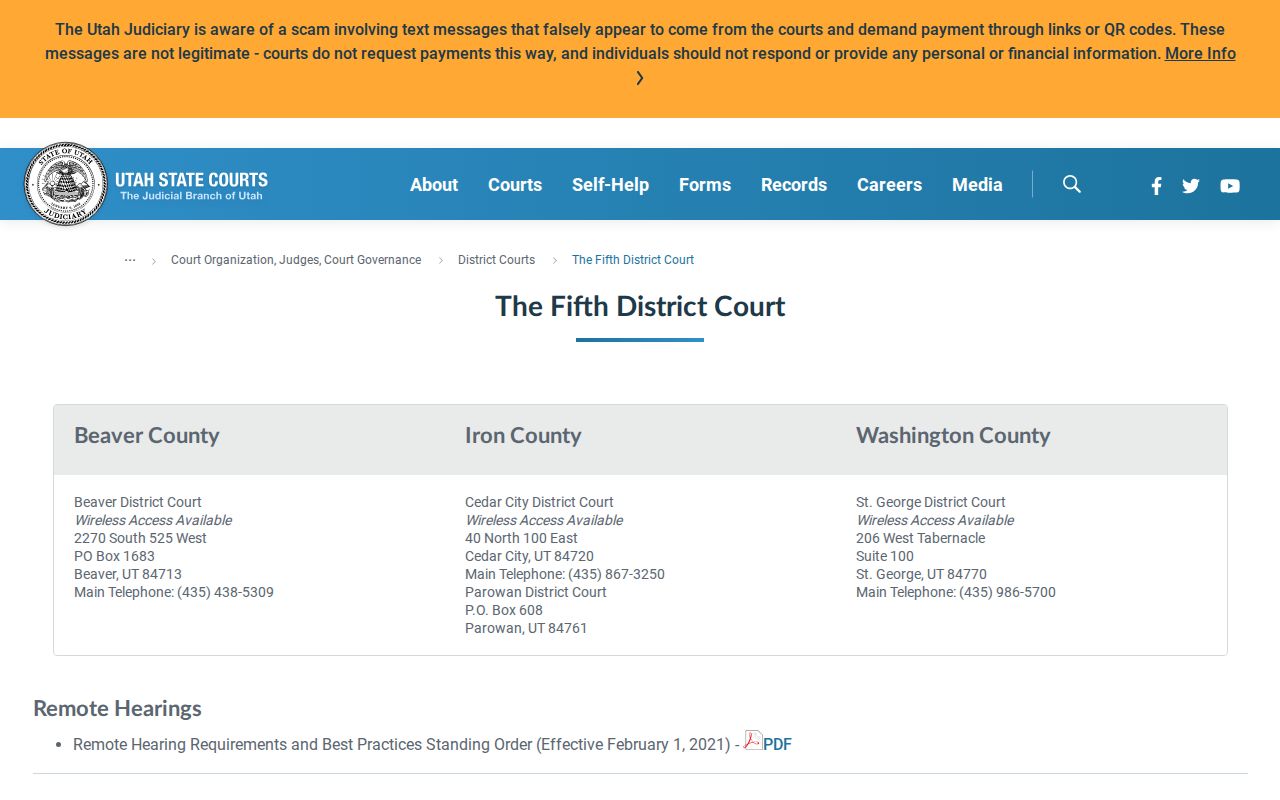
The state page stays the place to check for District Court service links, copies, audio, and courthouse contacts. Remember that the county Justice Court is a different office with its own record set.
Court Dates and Settings in St. George
Skip Xchange for schedules and go to the Utah Courts calendar instead. Pick the St. George District Court, or the exact Justice Court named on the case. Each entry can show the date and time. It may list the judge, the courtroom, the case type, and whether the setting is in person or hybrid. Weekday updates keep the calendar fresh. Still, a posted setting can change. Treat it as a plan rather than a promise.
| Date and time | The listed St. George setting, subject to later reset or cancellation. |
|---|---|
| Appearance mode | In person, remote, or hybrid as the event states. |
| Courtroom | A room code such as those used in District Court output. |
| Setting type | Initial appearance, motion, review, trial, or another event. |
| Remote link | A Webex link when published; otherwise contact the court. |
When a filed notice conflicts with the calendar, let the clerk settle it. Call the St. George court and confirm the real date.
St. George Hybrid Docket Access
Some entries on a St. George calendar read “Hybrid Virtual/In Person Hearing.” If a Webex link appears, the public can attend through it. No link? Contact the judge's team or the court location instead. Attending openly never permits recording, photographing, or transmitting the proceeding.
A listing only proves a setting was scheduled. It says nothing about what happened. It does not say how the case ended. For results, request the minute entry, order, audio, or another court record from the clerk. That distinction matters. It keeps a St. George docket search from turning a tentative schedule into a false conclusion.
Traffic Tickets in St. George
Start a St. George ticket search with the issuing agency and court printed on the citation. Here is the catch: citation numbers are not unique across Utah. Pair the number with its location, or you may pull the wrong case. Xchange shows the case history. The Utah calendar shows any listed court date. And the local clerk can confirm you found the right St. George court docket.
County guidance warns that a new county ticket can take up to seven days to appear. That timing belongs to the county venue. Do not assume it for every ticket. The same FAQ notes that St. George City citations may follow a separate city traffic-school route. For the wider citation procedure, read the Washington County traffic ticket record explanation.
St. George Juvenile Docket Boundary
The Fifth District Juvenile Court sits inside the same 206 West Tabernacle complex. It handles Washington County juvenile matters. Those cases stay out of ordinary public Xchange searches. A blank name search proves nothing about whether a juvenile matter exists.
The official juvenile court page lists the court contact and separates court operations from probation services. A parent, guardian, party, attorney, or other authorized person should ask the juvenile clerk about the restricted-access process. Public users should stop there. Do not try to infer private juvenile facts from the open St. George docket.
Where St. George Cases Go
Venue follows jurisdiction, not distance. Lower-level matters filed with Washington County Justice Court stay on that Justice Court docket. Felonies, class A misdemeanors, and general civil, probate, or domestic matters are different. They move through the St. George District Court. Appeals generally leave the local trial docket for the Utah Court of Appeals.
Docket flow: St. George limited-jurisdiction route › Washington County courts › Utah District Court, Fifth Judicial District.
Never assume a case near the county seat sits in one database entry. The filing tier decides. When that tier is unclear, the Washington County court docket overview supplies the county-level court map.
St. George Federal Docket Fork
The St. George Federal Courthouse also sits at 206 West Tabernacle, in Room 2200. It serves as the Southern Region hearing location. That venue belongs to the U.S. District Court for the District of Utah. One street address, two court systems. Federal and Utah state dockets carry different clerks, case numbers, and filing systems.
The federal courthouse page names the venue and contact. Federal civil and criminal records run on CM/ECF and PACER, not Utah Courts Xchange. Bankruptcy hearings may occur in St. George. Bankruptcy clerk work is centralized elsewhere. Keep a federal docket entirely outside the state St. George docket workflow.
St. George Court Record Access Rules
Utah's judicial-record rules govern public St. George court records. Rule 4-202.02 classifies records as public, private, protected, sealed, or otherwise restricted. Rule 4-202.04 spells out a reasonably specific written request to the court clerk. GRAMA covers government records. But a county administrative request cannot replace a judicial case-file request.
Key rules:
UCJA Rule 4-202.02 identifies public and restricted court-record classes.
UCJA Rule 4-202.04 governs requests, denials, and the challenge process.
Utah Code 63G-2-201 addresses access to public government records outside the distinct judicial rules.
Part of a St. George court file restricted? Ask the clerk for the public or redacted portion.
Historic St. George Docket Records
Modern Xchange coverage is only one layer of the St. George record. The Utah State Archives Fifth District guide traces the district back to 1896. Washington County civil and probate series also begin in 1896. The series include indexes and microfilm. Some gaps are documented. Researchers should bring the county, court, approximate year, party name, and case number if known. The archive may need a series number or reel reference.
A current name search can miss an old paper file or a record predating conversion. Certified modern copies and hearing audio remain clerk requests. Archival holdings may require a separate repository search.
Document depth in Xchange varies by date too. Utah Courts says District Court document availability is strongest for papers filed since July 1, 2010. Most District Courts used the current record system by the end of 1998. An older St. George result may offer an index clue without the full electronic file. Record the case number and court exactly before contacting the archive or clerk.