
Searching Washington County Criminal Dockets
Most people start with Utah Courts Xchange. It is the statewide public case-information system covering Washington County District and Justice Court records. Pick the right court and venue before anything else. The St. George District Court search handles felonies and class A misdemeanors. Most class B and C misdemeanors, infractions, and local ordinance cases start in a named Justice Court instead. A broad statewide sweep can pull in unrelated names. It can also run up needless search charges. Narrow the scope early. The full case number is your best tool when you have it. Xchange itself warns that case numbers are not unique across Utah. Pair the number with Washington County, the court, the case type, or the filing year. No number? Search a complete last name, a first name or wildcard, a court scope, and the likely year. Confirm the filing date and code before you pay to open history or documents.
- Select District Court, Justice Court, or both only if venue is unclear.
- Choose Washington County and the specific court location.
- Enter the full case number or a narrow name search.
- Compare court, type, date, and party role.
- Use the calendar for settings and the clerk for certification.
Washington County Criminal Docket Codes
Every Washington County criminal docket carries a code. The official Xchange code table sorts them into groups that make a docket search easier: FS State Felony, MD Misdemeanor DUI, MO Other Misdemeanor, and IF Infraction. A code narrows the search. It says nothing about guilt, sentence, or outcome. The official page lists the Utah-specific categories, which keeps a generic abbreviation from being mistaken for Utah court language.
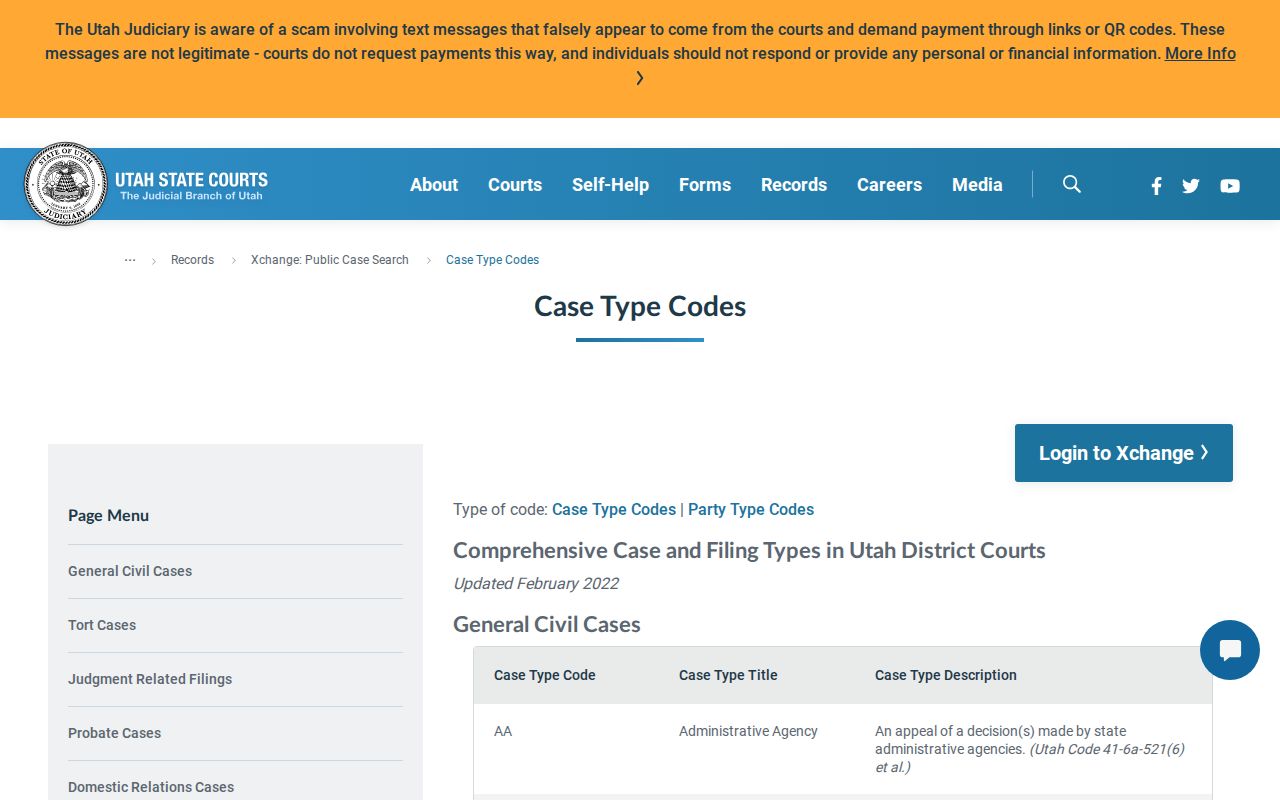
Traffic and civil case families get their own codes, so seeing one of those is a good clue the docket search landed in the wrong group.
Inside a Washington County Criminal Docket
A single Xchange result row barely scratches the surface. Expand the Washington County case history and you can learn the court, filing date, case type, parties, attorneys, public charges, settings, and accounting entries. Documents may cost extra. Just remember that restricted material stays restricted even when the main case has a public row.
| Case number | Utah identifier; pair it with court and venue. |
|---|---|
| Charge and class | Public count, classification, and code where displayed. |
| Setting | Date, time, judge, courtroom, mode, and hearing type. |
| Plea | Entered plea or coded event read in context. |
| Disposition | Dismissal, judgment, transfer, vacation, or other result. |
| Documents | Public motions, notices, orders, and minute entries. |
Accounting entries can show bail, fines, restitution, payments, and due dates. They are not a full sentence order. When the exact obligation matters, read the filed order itself.
Washington County Criminal Docket Workload
Curious how busy the court is? The FY2023 Washington District Court report recorded 1,406 State Felony filings, 1,070 Other Misdemeanor filings, 219 Misdemeanor DUI filings, and three Infractions. The criminal total came to 2,789 filings and 2,809 dispositions, a 101 percent clearance ratio.
These are case-category totals, not counts of people. They are not proof of guilt either. They do explain why court and case-type filters matter when a Washington County criminal docket search by name returns a pile of matches.
How a Criminal Case Moves
A Washington County criminal docket reads in chronological order. But no case must pass through every event. Filing opens the record. The initial appearance marks first court contact. A preliminary hearing tests a felony case at an early stage. A bail hearing deals with release conditions. A motion hearing deals with a filed request. A trial setting is just a future event, not a verdict.
Docket flow: Filing › Arraignment › Pretrial › Plea or Trial › Disposition › Sentencing
Outcomes get codes too. The Utah judgment and disposition list defines codes for guilty plea, no contest, plea in abeyance, dismissal, transfer, vacation, and expungement. Meaning depends on the column and context. The filed order controls.
Washington County Criminal Calendar Settings
Need current settings? The free Utah court calendar lets you confirm a Washington County hearing by case number, party, judge, attorney, date, and location. It may list an initial appearance, preliminary hearing, bail hearing, motion, review, or trial. A listing only tells you what is scheduled. It does not give the full case history or prove the event ever happened.
- Setting
- A court event placed on the calendar.
- Reset
- A setting moved to another date or time.
- Minute entry
- The written record of what occurred.
- Disposition
- The recorded outcome of a charge or stage.
Calendar information refreshes on weekdays at 5:30 a.m. Check again close to the hearing, and call the court if the mode or room conflicts with a notice.
Courts That Hold Criminal Dockets
Where does the docket live? The Fifth Judicial District St. George District Court holds Washington County dockets for state felonies and class A misdemeanors. Six Justice Courts keep separate limited-jurisdiction records: Washington County, Enterprise, Hildale, Hurricane, Santa Clara, and Washington City.
| Court | Docket covers | Search route |
|---|---|---|
| St. George District Court | Felonies, class A misdemeanors | Xchange, calendar, clerk |
| Justice Court | Most class B/C misdemeanors, infractions | Xchange, calendar, local clerk |
| Juvenile Court | Juvenile matters | Excluded from ordinary public results |
| Federal court | Federal offenses | CM/ECF and PACER |
Two courts hold criminal dockets here: St. George District Court and Washington County Justice Court. The Washington County Clerk/Auditor does not serve as the clerk of courts.
Missing Washington County Criminal Dockets
A blank Washington County criminal docket search is not a criminal-history conclusion. Before giving up, test spelling, initials, wildcard use, year, venue, and court level. Older Justice Court conversion dates vary. Converted matters may hold less electronic detail than you expect. Public Xchange leaves out sealed and expunged matters, juvenile cases, mental-health records, and criminal “NA” cases. For older files, ask the Fifth District clerk. Or turn to the Utah State Archives Fifth District guide. A clerk can sort out public or redacted access. But the clerk cannot release a private file without authority.
Search check: Confirm court, venue, year, and case type before treating a missing result as meaningful.
Sealed Dockets and Public Access
Two rules govern who sees what. UCJA Rule 4-202.02 preserves access to public court records while classifying sealed, private, and protected material. Rule 4-202.03 defines who may inspect nonpublic records.
Access routes: Use Xchange for remote history, the free calendar for settings, a free CORIS terminal or State Law Library access, and the relevant clerk for copies.
Rule 4-202.04 allows a reasonably specific written request and provides a process after denial.
A certified order has to come from the court holding the file. County GRAMA covers county administrative records. It does not cover criminal case files. Is the court level uncertain? The broader Washington County case lookup helps you narrow it down. Note: Confirm any consequential docket reading against the originating clerk’s current record and filed order.
Washington County Criminal Docket Terminals
You do not have to sit at a computer to pull a Washington County criminal docket. Utah Courts places free public CORIS terminals inside courthouses. It also offers free Xchange access through the State Law Library. A terminal spares you the Xchange search charges, though copy and certification fees can still apply. The Fifth District Clerk holds the St. George District Court criminal file. Each county or city Justice Court clerk holds that court's limited-jurisdiction file instead.
Call ahead only after you have your details in hand. Bring the complete case number. Bring the court location, the public party name, the filing year, and the exact document you want. Say whether you need to inspect, a plain copy, or a certified copy. A quick phone call confirms venue and the current procedure. A specific written request keeps the scope clear. One warning matters here. Never send a District Court case request to the Washington County Clerk/Auditor. Both offices use the word clerk. That does not make them the same office.
Age affects what any search turns up. Older records may sit in archives. They may need manual clerk review. Electronic conversion was not uniform across all Justice Courts. So a thin online entry for an older Washington County criminal docket does not mean no case existed. When the remote search runs dry, the fallback chain is simple. Use public terminals first. Then the clerk. Then the archives.
Washington County Criminal Docket Costs
Xchange puts a price on remote work. The registration page lists a guest account at a $10 one-time fee. Searches run $0.20 each, and documents cost $1 each. A guest session lasts 24 hours. It can end after 30 minutes of inactivity. It may also lose unused credit when the browser closes. The subscription runs $25 to set up plus $40 per month. That tier includes 500 searches and charges $0.35 for additional searches. Documents stay at $1. Verify all rates before use.
If you search only now and then, set your filters before anything billable starts. Court level, venue, code, year, and an exact name cut down false matches fast. Party to the case yourself? You may qualify for MyCase, which Utah Courts describes as a party-facing service. MyCase is not the open public search for another person's docket.
Free routes still matter. Courthouse CORIS terminals and State Law Library Xchange access can avoid remote search fees altogether. What they cannot do is override sealed or private classifications. They cannot turn a plain screen view into a certified record either. For a certified order, sentence, or minute entry, ask the holding clerk.
Age shapes document availability too. Utah Courts reports strong District Court coverage for papers filed since July 1, 2010. Most District Courts used CORIS by the end of 1998. Justice Court conversion dates vary. A Washington County docket row may appear, but the paper you want may not. Note the docket date and title before calling the clerk. The missing download may reflect age. It may reflect conversion history, access classification, or a filing indexed without a purchasable image. None of that means the filing never existed.