
Searching Washington County Civil Dockets
Start a Washington County court docket search through Utah Courts Xchange, which carries public District and Justice Court case information statewide. Most civil, domestic, probate, and judgment lookups here run through St. George District Court. Small claims are different. The Justice Courts keep those within their limited authority. Pick your jurisdiction and court first, then search by name, company, case number, date range, or case code.
A full case number is your strongest tool. It still is not unique statewide, so pair it with the court and with Washington County before you trust the results. For name searches, spell the name exactly, use a first-name wildcard where Xchange allows it, and add a filing-year range plus the likely case code family. Every query can trigger a search charge. Narrow your input before you submit it.
- Identify District Court or the specific Justice Court.
- Choose all cases or judgments-only.
- Enter a case number, person, or legal company name.
- Apply the Washington County court, code, and date filters.
- Confirm the result before opening history or a paid document.
Washington County Civil Docket Volume
The FY2023 Washington District Court report logged 2,827 General Civil filings against 2,664 dispositions. Debt Collection dominated the criminal docket's civil cousin, with 2,151 filings and 2,060 dispositions. Contracts added 385 filings and 344 dispositions, while Civil Stalking contributed 111 filings and 108 dispositions.
Keep in mind these FY2023 figures count case categories, not unique parties. Debt collection looms so large that company names, judgment-only searches, and tight date filters pay off in a Washington County civil docket search.
Inside a Washington County Civil Docket
Each result row lists the county, court, case type, case number, filing date, party details, and a Case History/Documents link. Open the history and you may find pleadings, service, motions, orders, hearings, judgment entries, attorneys, and the closure. One caution: a public row in the court docket does not make every attachment public.
| Case number | Utah identifier paired with court and filing year. |
|---|---|
| Case type | Civil, domestic, probate, judgment, or small-claims code. |
| Parties | Plaintiff/petitioner and defendant/respondent where public. |
| Docket entries | Pleadings, service, motions, notices, and minute entries. |
| Orders | Interim rulings, judgment, decree, dismissal, or closure. |
| Settings | Current hearing data, which should be checked in the calendar. |
Buying a document through Xchange does not make it certified. If you need a certified copy, ask the clerk and name the precise order, decree, or judgment.
Washington County Civil Docket Codes
The Utah case-code table sorts cases into general civil, domestic, probate, judgment, and Justice Court groups. The grouping is not decoration. Pick the wrong family and you may miss a valid Washington County docket entirely, or drown in unrelated court records.
| Family | Examples | Search point |
|---|---|---|
| General civil | Debt, contract, lien, writ | St. George District Court |
| Domestic | Divorce, custody, protective order | District Court with privacy limits |
| Probate | Estate, guardianship, conservatorship | District Court; classification varies |
| Judgment | Tax lien, foreign judgment, abstract | Judgments-only may help |
| Small claims | Limited civil claim | Named Justice Court |
Treat the code as a locator, not a verdict on the merits. A judgment code can lead you to a separate judgment docket instead of the civil case where the dispute began.
Civil Case Types on the Docket
Civil dockets in Washington County cover far more than ordinary lawsuits. The FY2023 report lists a wide range. Contracts, collection, civil stalking, out-of-state deposition notices, writs, forfeiture, interpleader, and small-claims de novo matters all appear. "De novo" simply means the District Court holds a fresh hearing after the limited-court case. It is not just a review of the old docket entries.
Domestic filings came to 1,228. Of those, 745 were Divorce/Annulment and 325 were Protective Order filings. Probate added 621 filings. Judgment filings were the largest group at 3,910, covering tax liens, child-support liens, foreign judgments, and abstracts. Because each group carries different public-access boundaries, the right case code and a precise document request matter as much as the party name.
Remember that a category total measures local workload. It says nothing about the result or legal weight of any individual Washington County case.
Washington County Civil Record Boundaries
Privacy in Utah's domestic cases is partial rather than absolute. Under UCJA Rule 4-202.02, much of a public case history can stay open: judgments, orders, decrees, letters of appointment, records of public hearings. Protected filings and personal data are what stay sealed. Adoption, commitment, and certain name-change records get tighter treatment still.
Public does not mean complete: Ask for a public or redacted copy and the record classification when a known Washington County filing does not appear remotely.
Rule 4-202.03 decides who gets to see the private material in a Washington County civil docket. A party to the case can reach it through MyCase. An unrelated researcher using Xchange cannot.
Civil Docket Settings and Hearings
The Utah court calendar covers many kinds of settings in a civil case. Motions, status or review settings, evidentiary hearings, oral arguments, trials, and order-to-show-cause reviews all appear. Remember that a calendar entry is not the full docket. It tells you the scheduled event, the mode, the judge, the room, the date, and the time.
Read a setting carefully. A trial on the calendar does not prove the trial happened. Nor does it prove judgment was entered. A motion can show up in case history even before any hearing is set. A motion is a request, not a ruling. Look for a later minute entry or order in the docket before drawing conclusions. When you need formal proof, ask the proper clerk for the minute entry, order, transcript, or audio. The Washington County court dates resource explains the calendar fields in more detail.
Washington County Civil Judgment Dockets
Hunting a judgment in Washington County may take a second pass. The local FY2023 report counted 3,910 judgment filings and 3,885 dispositions. Big blocks of tax liens and child support liens are in the mix. Xchange lets you search all cases or judgments only. The official code table sorts entries into categories such as abstract judgment, foreign judgment, judgment by confession, workforce lien, and wrongful lien.
Search by party or legal entity name along with the judgment category, even if you already know the originating civil case number. Then compare filing date, court, and case link. That is how you make sure you have the right record. The Utah judgment code list helps decode an entry, but the filed judgment itself controls. For a certified copy, request it from the court that holds the record.
Washington County Civil Docket Access
Washington County splits civil docket access across several channels. Remote Xchange, a free CORIS terminal, free State Law Library access, and MyCase each serve a different need. MyCase serves the parties. Everyone else leans on Xchange or a terminal. The clerk helps too. Under UCJA Rule 4-202.04, the clerk can accept a written request that describes the record with reasonable specificity. One filing path leads elsewhere, though: state court files never enter the Washington County Clerk/Auditor's county GRAMA queue.
For current District Court records, contact the Fifth District Clerk at St. George District Court. A small claim goes to its Justice Court clerk. Ask for inspection, a plain copy, or a certified copy. Give the case number, document title, and filing date if you know it, and confirm current fees under Rule 4-202.08.
Washington County Civil Docket Archives
Electronic coverage only reaches part of the history. Older cases live on paper and microfilm. The Utah Archives Washington civil series starts in 1896 and holds case files, microfilm, and an index covering 1896 through 1937. The probate series also begins in 1896. It reaches back to territorial-origin material and has documented gaps.
For an old Washington County civil docket, the archival series description is a better starting point than repeating a modern Xchange name search.
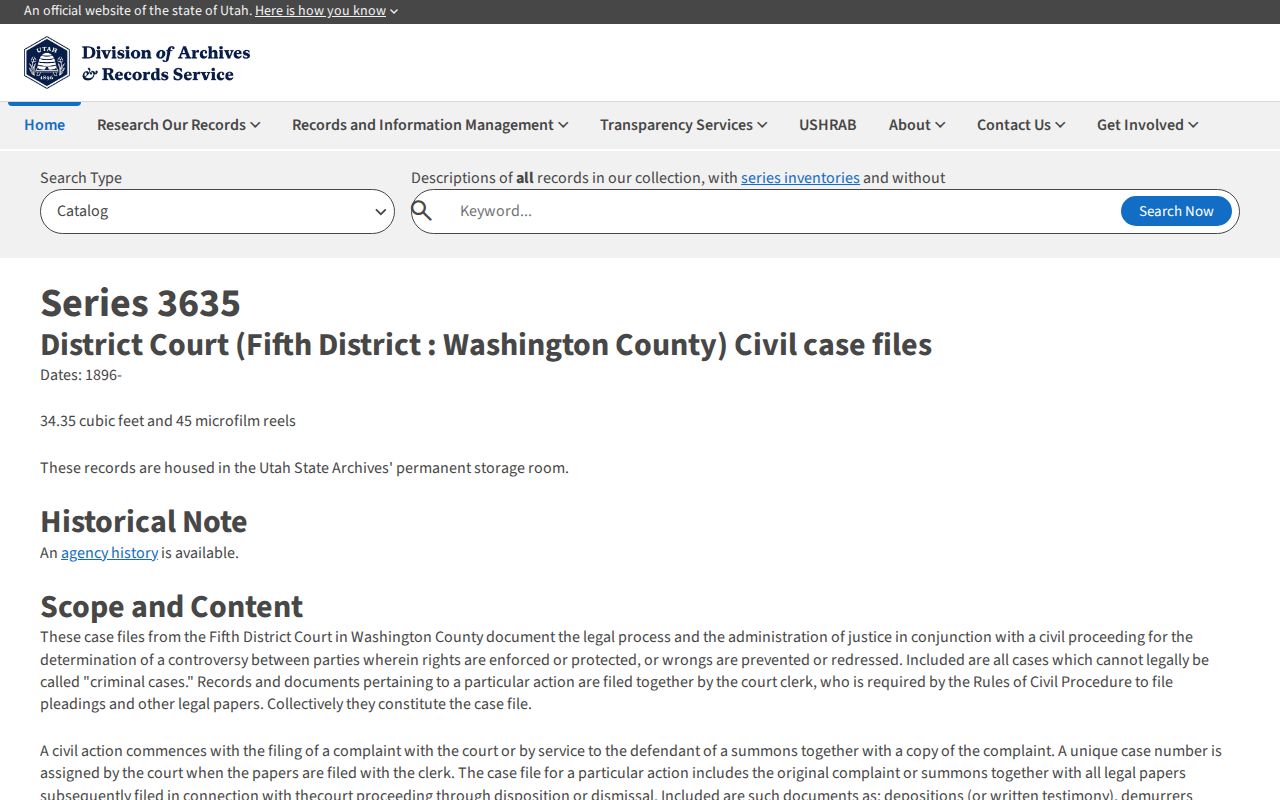
When you write to archives staff, give the county, case number, names, date range, and likely series. Ask whether an index or microfilm reel is needed first.
Certified Washington County Civil Records
A screen view, a downloaded docket, and a certified court record do different jobs. Xchange can spot a Washington County civil filing and sell a document copy. That copy is not certified by itself. Certification for a District Court decree, judgment, order, or other public paper comes from the Fifth District Clerk. A small-claims file stays with its Justice Court clerk.
Send the complete case number, court location, document title, and approximate filing date. Ask the clerk the current fee. Old Washington County forms carry amounts that may be stale. Utah judicial fee authority can change. If part of a civil record is private, request a public redacted version. The difference matters most in probate and domestic cases. Public sources may name an order while its attachments stay protected. A certified public order does not unlock a private exhibit.
When access is denied, the court can state its classification basis. Rule 4-202.04 supplies the written-request route. The clerk route also works when Xchange lists an entry. That covers a common gap. The docket may show the case but offer no document itself.
Washington County Civil Search Systems
Xchange and MyCase serve different civil-record needs. Xchange is the public research tool for District and Justice Court information. MyCase belongs to the parties. Utah Courts lets a party view case history and filed papers, link cases, and pay eligible fees. Self-represented filing is offered there too, in listed matters. Those matters include debt collection, eviction, small claims, protective orders, and name or sex designation proceedings.
A Washington County civil docket researcher who is not a party should use Xchange, the calendar, a public terminal, or the clerk. A party may see material the public cannot. Neither service reclassifies a private domestic or probate document. Attorneys file through the court's attorney efiling channel, not public Xchange.
Match the tool to the need. Need only a hearing date? Start with the free calendar. For filing history, Xchange or party access answers; for a certified decree or order, contact the clerk. That sequence saves paid searches. It also keeps a scheduled setting from being confused with the record of what actually occurred.