
Hurricane Docket Search Failures
A blank result on a Hurricane docket search can mean several things. The venue might be wrong. A name might be spelled differently, or a citation number might be incomplete. Filing delays, older converted cases, and restricted access also hide matters. None of that proves the case does not exist. Was it actually filed at Hurricane Justice Court? Recheck anything that started in La Verkin or at a named territorial facility. Then narrow Xchange by court, case type, and year. If both the state calendar and the case system stay unclear, call the Hurricane clerk with the original document in hand. Ask about a public or redacted portion rather than demanding restricted material.
Hurricane Xchange Docket Search Costs
Xchange guest terms charge a one-time account fee. There is also a fee per search, plus a separate price for each document. A search can cost money even when it turns up no useful Hurricane match. So gather your details first. Bring the venue, the full number, the name spelling, the case type, and the date range before you submit anything. Open a document only after the result fields confirm the right court and matter.
Free Xchange access exists at the Utah State Law Library. Utah Courts says public terminals sit in most District Courts. They may appear at Justice Courts. Call Hurricane Justice Court before counting on a terminal, hours, or printing. Free database access does not extend to certification, copies, audio, or staff research.
Hurricane Clerk Docket Requests
Contact Hurricane Justice Court directly when the online record runs thin. Have the case or citation number, the party name, an approximate filing or violation date, and the exact item you want. Say whether you seek inspection, a plain copy, certification, or audio. For audio, include the exact hearing date and time if you know it. A focused request helps the clerk separate similar matters.
Conversion dates vary by Justice Court. So an older Hurricane case may carry less electronic detail than a fresh filing. A calendar can show a scheduled setting. But it cannot replace the minute entry, disposition, or order. The clerk can also explain the file's status. That includes whether part of it is public, redacted, private, sealed, or otherwise restricted under Utah judicial rules.
Confirm every fee when you make the request. Older local forms list values that may no longer control. Rule 4-202.08 permits a current service schedule. A county administrative GRAMA form will not substitute for a Hurricane judicial file. Send the request to the court that created and maintains the docket.
Searching the Hurricane Court Docket
Begin locally. The Hurricane Justice Court page carries venue details, contact information, forms, and calendar links. Xchange serves as Utah's public case-information service for District and Justice Courts. The statewide calendar is a separate public schedule search. In both systems, select Hurricane Justice Court instead of sweeping every Washington County venue at once. No number is unique statewide. Use the full case or citation number when you can, but pair it with the court location. A name search should add a case type and an approximate year.
- Read the court and agency printed on the source document.
- Select Hurricane Justice Court in Xchange.
- Narrow the Hurricane docket result by number, name, type, and year.
- Check the Hurricane location in the Utah calendar.
- Confirm the date or record request with the local clerk.
Hurricane Docket Beyond City Limits
Hurricane Justice Court covers Hurricane and La Verkin. Its official description also reaches Sand Hollow State Park, Quail Creek State Park, the Washington County Fairgrounds, and Purgatory Correctional Facility. The right venue can therefore turn on a facility or a law-enforcement route rather than a municipal mailing address.
| Place clue | Search implication |
|---|---|
| Hurricane or La Verkin | Check Hurricane Justice Court |
| Sand Hollow or Quail Creek | Read the citation venue before assuming another court |
| County Fairgrounds | Use the named court on the filing |
| Purgatory facility | Confirm case class and Hurricane venue |
This wider footprint is the defining Hurricane docket distinction.
Hurricane Municipal Court Basics
Hurricane Justice Court sits at 80 South 700 West, Hurricane, Utah 84737. Its listed phone is (435) 635-4072. The fax is (435) 635-5066. The court handles class B and C misdemeanors, infractions, city ordinances, and traffic matters. It does so within its stated authority. Adult criminal jurisdiction starts at age 18, with limited traffic treatment described for some 16- and 17-year-olds. A Hurricane court docket is not the Washington County Justice Court docket. Each clerk keeps the record for that venue. Felonies, class A misdemeanors, and general-jurisdiction matters go to the state District Court in St. George.
Hurricane Court Docket Geography
The court's wide reach makes geographic guessing risky. Someone near Hurricane may hold a document filed elsewhere. Meanwhile, a matter arising outside city limits may still name Hurricane Justice Court. The court line printed on the citation beats any map pin.
When Xchange returns nothing, test the complete citation number with Hurricane as the location. Then run a narrow party-name search. Check the spelling and the filing year. Conversion dates vary across Justice Courts, so an older case can hold less online detail. The local clerk can tell you whether the matter lives only in the court file or under a different venue.
Court Dates and Settings in Hurricane
Hurricane Justice Court appears on the state's Utah calendar. The city's own page links a local calendar too. The state entry can list the date, the time, the judge, and the hearing type. It also says whether you appear in person or another way. Settings shift. Run the docket search again right before the hearing, since a reset may have followed your earlier lookup.
| Date and time | The current Hurricane setting, subject to court change. |
|---|---|
| Mode | In-person, remote, or hybrid when expressly shown. |
| Venue | Hurricane Justice Court, not merely Washington County. |
| Setting | Initial appearance, pretrial, trial, review, or other event. |
| Case type | The Utah category tied to the scheduled case. |
The captured calendar layout shows fields without exposing private identifiers.
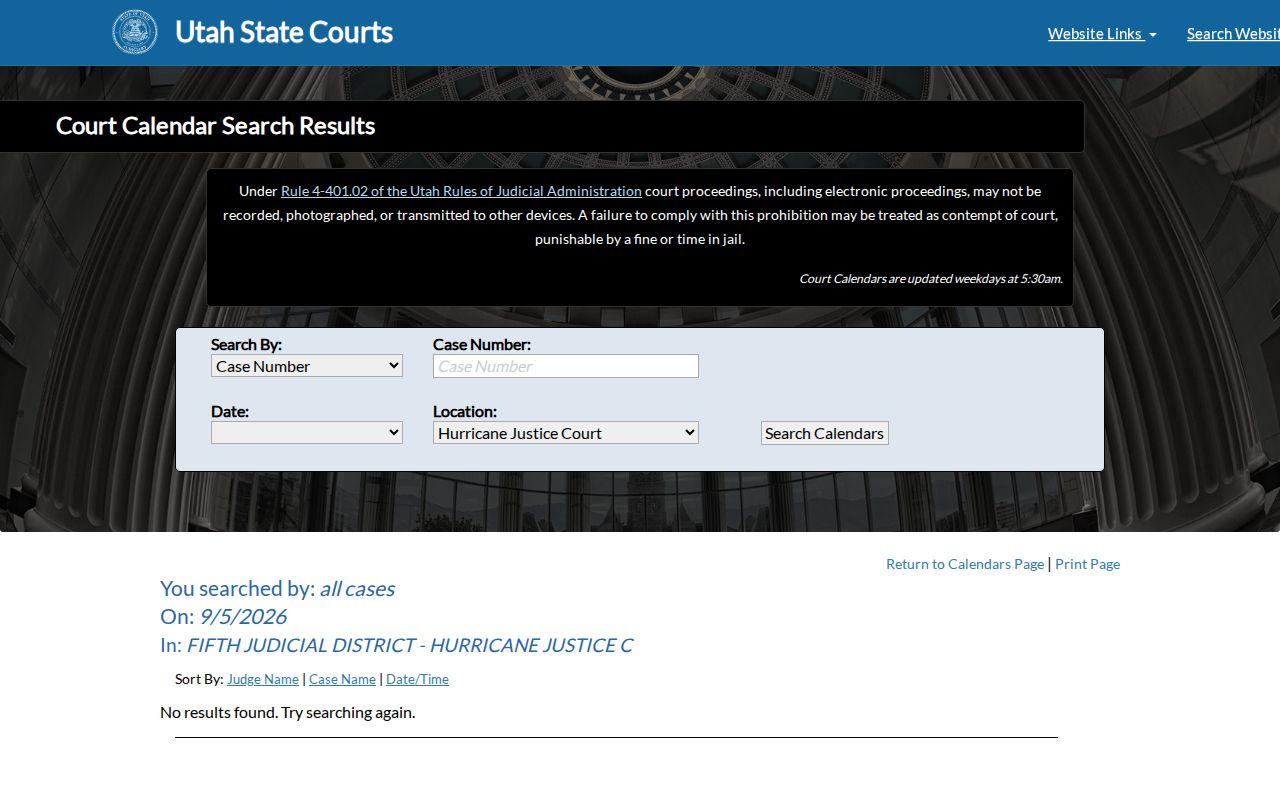
Use the image as a field guide, then retrieve a current Hurricane docket result.
Hurricane Domestic Violence Docket
The Hurricane court page links a domestic-violence calendar. It also cites Utah law for one hard rule: an initial appearance in such a case cannot be waived. The page describes a next-Wednesday scheduling practice as well. Calendars and weekly instructions change. Confirm your real date with the court itself.
A specialty-calendar label tells you almost nothing about a private person. It has one narrow scheduling purpose. Protected information and restricted filings still follow Utah court-record rules. Appearance duties are at stake? Rely on the filed notice and the clerk. Skip any general Hurricane docket pattern.
Traffic Tickets in Hurricane
A Hurricane traffic ticket can come from the city. It can also come from La Verkin or the named territorial areas. The citation names the court. Search Xchange with the citation number and the Hurricane location. Then check the calendar for the court date. The city page also links Utah's Uniform Fine and Bail Schedule. It covers payment details and traffic-school information too.
A fine schedule does not promise you can close every case by paying. Some charges demand an appearance or other court action. Contesting a citation? Follow the court's current response route instead of paying first. For county-wide concepts, see the Washington County traffic ticket search.
Hurricane Small Claims Docket Caveat
Here is a conflict worth knowing about. The Hurricane page still describes a $15,000 small-claims limit, while the 2025 Utah Courts annual report describes statewide Justice Court small-claims authority up to $20,000. The two official sources differ in both age and amount. Treat the older city text as background, not as the current ceiling.
Verify first: use the current Utah statute, current court form, and Hurricane clerk before filing or describing the applicable small-claims limit.
This is a publication-age problem, nothing more. It does not prove that any specific Hurricane case was accepted or rejected. The case docket and the filed documents control the individual matter.
Where Hurricane Cases Go
Where a Hurricane case lands depends on the charge. Class B and C misdemeanors, infractions, ordinances, qualifying traffic matters, and small claims can stay with Hurricane Justice Court. Felonies and class A misdemeanors are different. So are general civil or domestic cases; those usually belong to Utah District Court in St. George. An appeal follows Utah's assigned appellate path rather than remaining a city docket.
Docket flow: Hurricane Municipal Court › Washington County courts › Utah District Court, Fifth Judicial District.
A blank city search is not proof of a transfer. Figure out the charge level and venue first. Then move to the county-level case lookup if the Hurricane docket search shows no proper match.
Hurricane Docket Codes and Fields
An Xchange result can show court, location, case type, case number, filing date, party code, and a Case History/Documents link. Open the history and you may find charges, plea, disposition, judge, attorneys, due dates, accounting, and filed documents. Two-letter Utah codes mean nothing on their own. Read them beside the official code table.
- Setting
- A scheduled court event, not a final outcome.
- Disposition
- The recorded resolution or status, which may use an official code.
- Reset
- A move from one setting to another date.
- Case history
- The chronological entries made in the Hurricane court record.
A calendar and a docket answer different questions, so compare both when timing matters.
Hurricane Court Record Access Rules
Utah judicial rules govern Hurricane Justice Court files. The public may inspect records, though sealed, expunged, juvenile, adoption, mental-health commitment, and parts of domestic matters can be restricted. Put your written request in specific terms. Name the court, the case or citation number, the party, the date, and the exact record sought.
Key rules:
UCJA Rule 4-202.02 classifies public and nonpublic court records.
UCJA Rule 4-202.04 covers written requests and review of denials.
UCJA Rule 4-202.08 authorizes court-record service fees.
Call the Hurricane clerk for today's copy and certification fees.
Hurricane Docket Growth Context
Census QuickFacts puts the city at 25,745 residents as of a July 1, 2025 estimate, up from 20,036 in the 2020 Census. Those figures describe people, not Hurricane filings.
Growth numbers add local color. The broad territorial description also explains something. The Hurricane court docket cannot be measured by city population alone. Actual caseload claims need a court report and a defined reporting period.
Online access has limits. Xchange charges for guest searches and charges separately for documents. Free access is available at the Utah State Law Library. Public terminals may exist at courthouses too. A free terminal does not make certified copies or staff research free. Call Hurricane Justice Court before counting on terminal access, hours, or printing.
Conversion dates for older Justice Court files vary too. A historic Hurricane case may carry less electronic detail than a new filing. Keep the full case number, the approximate year, the charge or claim type, and the location handy. Those facts help the local clerk. The clerk can then tell an archived or lightly converted file from a case filed in another Washington County venue.